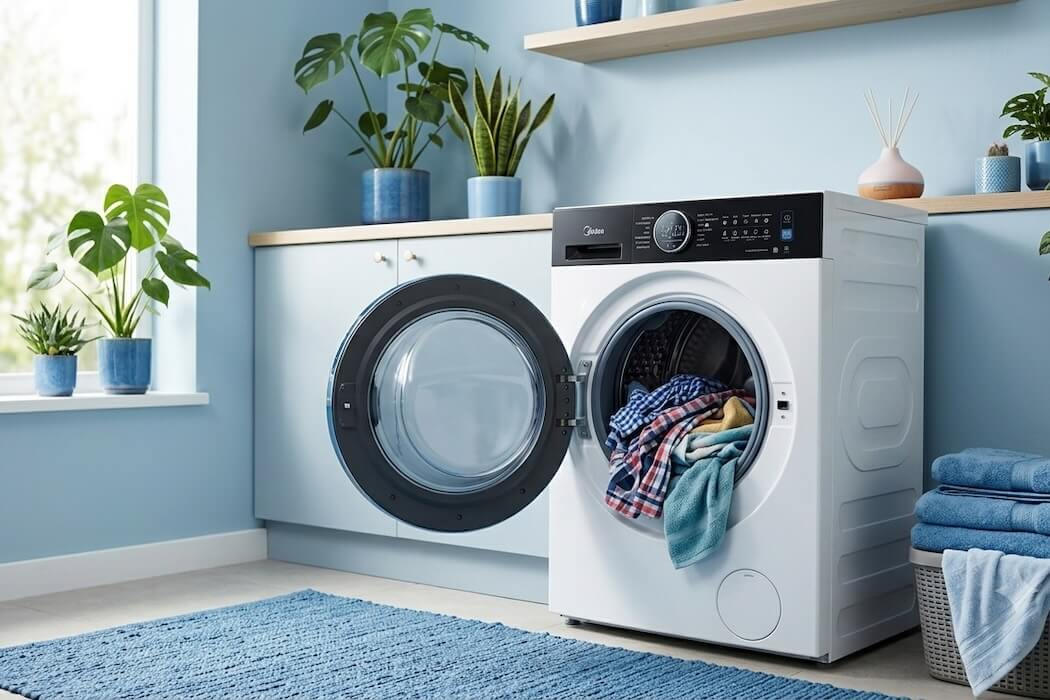
Laundry is one of those chores that quietly shapes a household. A machine that rattles the wall at 6am, or a dryer that turns a hot afternoon into a sauna, becomes part of daily life. So when Midea launched its 210 Front Load Washer and 210 Heat Pump Dryer in Australia, I wanted to look past the launch claims and ask what a buyer should actually weigh up before spending the money.
According to Midea, 39% of Australians now wash only in cold cycles, and about a quarter line dry their clothes. People are changing laundry habits to protect their power bills, so the question is no longer which machine looks best. It is which pair will cost less to run for the next decade.
That is where a front load washer and a heat pump dryer make a good partnership. Both are built around doing the same job with less energy and water.
Before looking at features, I’d grab a tape measure.
Space and layout. Midea pitches the washer as a “perfect fit” for balconies, bathrooms, kitchens and laundry cupboards, which suits smaller Australian homes and apartments. Measure the width, depth and height of the space, then add room for hoses, the door swing and airflow. The dryer has a reversible door, so you can hinge it left or right to suit a tight corner or a cupboard layout. That is a small detail that solves a real problem.
Ventilation. Heat pump dryers recycle their warm air instead of venting it outside, so there is no hose to push through a window or wall. That makes them a good fit for apartments. They still give off some warmth, so a bathroom with no airflow or a sealed cupboard is not ideal. Leave breathing room around the machine.
Noise. If the laundry sits close to bedrooms, as it does in many apartments, noise matters. Both machines use inverter technology (a BLDC motor in the washer, a dual inverter compressor in the dryer), which is designed to run more quietly. That makes an early morning or late night load less disruptive.
Plumbing and power. Check where your taps, drain and power point are before you buy. Also check the floor, because a full 10kg load spins with real force, and a solid, level surface keeps vibration down.
How these machines can help the household budget
Running costs are where this pairing earns its place. The numbers below come from Midea and the retailers listing the products.
The dryer carries a 10 Star Australian energy rating, which is the top of the scale. Heat pump drying uses far less electricity than a conventional dryer because it reuses its own heat. For anyone who avoids the dryer because of the power bill, that changes the maths, especially in winter or in an apartment with no clothesline.
The washer has a 4.5 star water efficiency rating. Its PowerMix technology pre-mixes detergent with water before it enters the drum. That helps the detergent dissolve properly and use water more efficiently. The Auto Dispenser measures the load and doses detergent for you, so you stop over pouring and wasting product. One detergent fill is meant to cover multiple washes.
Time is a cost too. The Turbo Wash cycle claims up to 30% faster washing, and a 15 minute cycle handles small loads, like a pair of footy socks or a school uniform that suddenly became urgent.
What it means for your clothes
This is the part I find most interesting, because efficiency means little if the clothes come out worse.
In the wash. Storm Wash creates five water flows (soaking, rubbing, penetrating, swinging and waterfall) to imitate hand washing. PowerMix Spray distributes foam across the load, so bulky items like towels and blankets are properly soaked. The 365mm door opening makes it easier to load those larger items. The Woolmark Green Label means the wool cycle has been certified for wool garments.
For hygiene. The washer flushes between its inner and outer drums with 90°C water to clean the machine itself. Midea says it removes lint and residue and sanitises with 99.99% effectiveness. A Health Guard sanitising function targets bacteria on clothes. A washer that cleans itself is a quiet benefit, since a neglected drum is where musty smells start.
In the dryer. Heat pump drying uses lower temperatures, which is gentler on fabrics and helps protect against shrinking and damage. Built in sensors adjust drying time and temperature to the load. There are dedicated modes for wool, kids wear and bed linen. After the cycle ends, an anti crease function tumbles the clothes for 30 minutes by default, or up to 120 minutes if selected, so they are not left in a wrinkled heap if you forget them.
Midea 210 Front Load Washer (MF210)
- Capacity: 10kg
- Motor: BLDC inverter motor, for quieter running and energy savings
- Cleaning tech: PowerMix Spray and Storm Wash with five water flows
- Dosing: Auto Dispenser senses load weight and doses detergent, with Midea Smarthome app control and low supply alerts for detergent and softener
- Speed: Turbo Wash saves up to 30% of wash time, and a Fast Cycle handles small loads in 15 minutes
- Hygiene: Tub Clean function and 90°C flushes, plus sanitisation
- Convenience: 365mm EasyLoad door opening
Mid 210 Heat Pump Dryer (MD210)
- Capacity: 10kg
- Energy rating: 10 Star
- Compressor: Dual inverter heat pump, for faster, quieter and more efficient drying
- Speed: Dries a 3kg load in 59 minutes
- Maintenance: Self cleaning condenser flushes lint using collected water
- Smart features: AutoLink syncs the drying mode to the washer’s cycle, and the app gives real time notifications and lets you set completion times
- Sanitisation: 99.9% deep sanitisation plus UV sanitisation
Installation: Reversible door
Other details
- Recommended retail price: $1,099 for the washer and $1,449 for the dryer
- Where to buy: Both are available through Bing Lee.
Colour: White - Smart features: The app needs a compatible home setup, so confirm your Wi-Fi reaches the laundry before you rely on auto dosing.
- Before you order: Measure the space, check the door swing, confirm your water and power points, and ask the retailer about delivery, installation and old appliance removal.
- Check the fine print: Warranty terms, whether you can stack the pair, and how the dryer handles condensate are worth confirming with the retailer or Midea.
If you are weighing up a washer and dryer on a tight budget and a tight floor plan, this pairing is built for exactly that situation. The headline numbers are the 10 Star dryer, the app controlled dosing and the quiet inverter motors. They make sense on paper, and what matters now is how they perform in real homes over time. I would want to see how the dosing, the noise and the drying times hold up in daily use before calling it a favourite. So.. who’s got space to fit in a new washer and dryer?