There is a particular kind of quiet that only happens after dark, away from the city. No notifications, no traffic hum, no glow bouncing off low cloud. Just you, a blanket on the grass and a sky so thick with stars it feels almost unfamiliar.
That quiet is becoming a reason to travel in its own right. As light pollution creeps further from our cities, and screens fill more of our downtime, a genuinely dark sky has become something you have to seek out rather than something you stumble into. More Australians are doing exactly that, trading the packed itinerary for something slower: a weekend built around nothing more than lying back and looking up.
Astrophotographers call the stretch between mid-autumn and mid-spring “Milky Way season,” the window when the galaxy’s bright core is best placed for viewing and photographing in the southern hemisphere. It also falls before daylight saving kicks in, when the earlier nightfall hands travellers more hours of darkness to actually make use of.
“We’re seeing travellers look beyond the traditional holiday checklist and seek out experiences that give them a reason to slow down,” says Nick Baker, CEO of Wilderluxe by Reflections. “The night sky doesn’t require an itinerary. You can simply sit outside, look up and enjoy where you are. For families, it’s a chance to put the screens away, spend quality time together and appreciate the simple experience of being under the stars.”
If a weekend away has started to feel like it needs a reason, this is it. Here are five NSW spots where the stars do most of the work.
Wilderluxe Lake Keepit
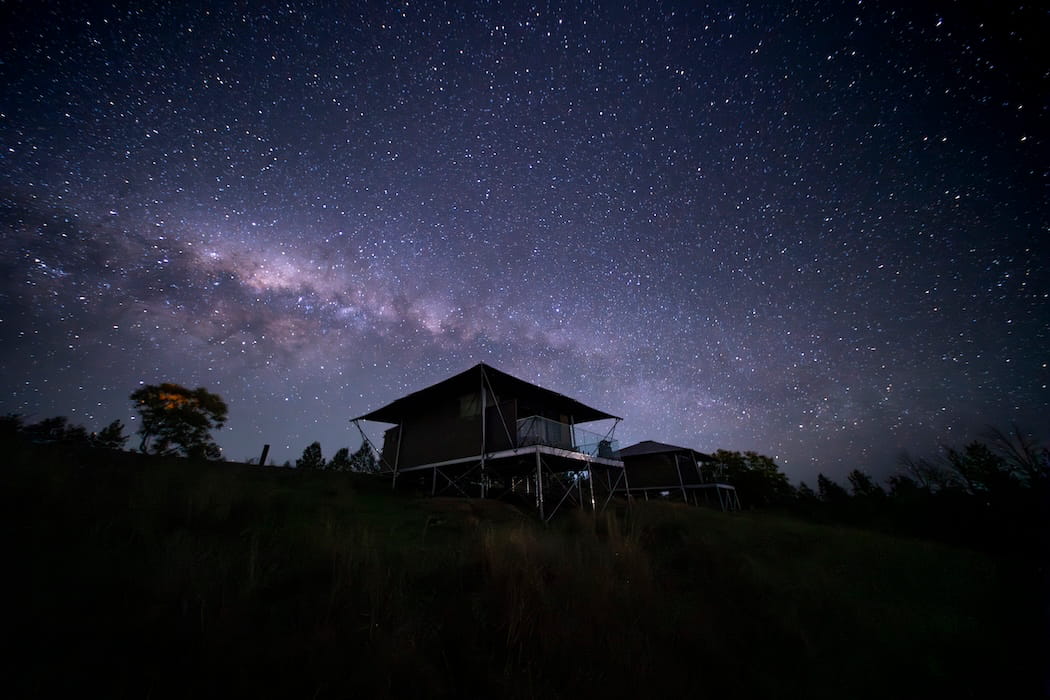
Out in NSW’s Big Sky Country, the landscape itself seems to tilt upward. Wilderluxe at Lake Keepit has built its entire experience around that fact, with a small collection of premium safari style tents fitted with stargazing skylights, private decks and outdoor baths.
Inside, the tents lean into comfort rather than roughing it, with plush king beds, timber furnishings and heating for the cooler months, so the experience reads more boutique retreat than traditional camping. You can soak under the stars before bed and wake up to them again through the roof of your tent, with nothing but bushland and the lake between you and the horizon.
For guests who want to go beyond simply looking, there is Big Sky Dreaming in the Gilay Lounge, an immersive film narrated by Kamilaroi storyteller Uncle Len Waters. It threads ancient stories together with Western astronomy, offering a version of stargazing that is as much about culture and connection as it is about constellations.
Blue Mountains
For Sydneysiders, the Blue Mountains remain the easiest possible exit from the glow of the city. By day, it is walking tracks, sandstone lookouts and mountain towns made for slow lunches. By night, the same lookouts that framed the Three Sisters at sunset turn into open-air observation decks, with the sky deepening from dusk blue to full black in a matter of minutes.
Accommodation across the region spans everything from heritage guesthouses in Katoomba and Leura to self-contained mountain cabins with their own fire pits, making it easy to find a base with a clear outlook and no streetlight in sight. Bring a thermos and stay a little later than planned.
Warrumbungle National Park
For those chasing something more serious, Warrumbungle National Park is the benchmark. As Australia’s first Dark Sky Park, it holds some of the clearest, least interrupted skies in the country, and is considered one of the best places on the mainland to see the Milky Way stretch fully overhead.
This is the kind of place astrophotographers plan trips around, but it rewards casual stargazers just as generously. Even without a telescope, the sheer density of stars visible here is enough to reset your sense of scale. Camping within the park itself is the classic way to experience it, with a handful of NPWS campgrounds offering unpowered sites close to the observatory, while nearby Coonabarabran has motels and farm stays for those who would rather have a bed and a hot shower waiting after a late night of sky watching.
Reflections Seal Rocks
Stargazing does not have to mean heading inland. At Reflections Seal Rocks, the same isolation that keeps the coastline quiet also keeps the sky dark. Spend the day on empty beaches, walk through the surrounding bush or climb up to Sugarloaf Point Lighthouse, then let the evening slow right down as the stars take over.
The park offers a range of stays to suit however you want to camp out under them, from fully equipped cabins with their own kitchens and outdoor decks, to safari style glamping tents for a step up from a standard tent, through to powered sites for those bringing their own setup. It is an easy, low-effort base for a weekend that mixes coast and cosmos, whichever way you prefer to stay.
Mudgee
Mudgee does country escape well by daylight, all rolling vineyards and long lunches, but it earns its place on this list after dark. Once the sun drops and the wineries close up, the same wide open land that grows the grapes clears the sky completely. Pair a day of cellar door visits with a night spent doing nothing but looking up, ideally with a glass of whatever you tasted that afternoon still in hand.
The region’s accommodation leans into that unhurried pace too, with vineyard cottages and farm stays scattered through the surrounding countryside, alongside boutique inns closer to town for those who want the cellar doors within walking distance.
What to Pack for a Night Under the Stars
A good stargazing trip needs surprisingly little gear, but the right few things make the difference between a memorable night and a cold, early retreat indoors.
- A proper blanket or picnic rug. The ground cools fast once the sun goes down, even in the warmer months. Something thick enough to sit on for a couple of hours is worth the extra bag space.
- Layers, not just a jacket. Regional NSW nights can drop sharply in temperature after dark. A beanie and a second layer you can add once the sun disappears will keep you outside longer.
- A red light torch. Regular torches and phone screens wreck your night vision in seconds. A red light setting, or a cheap red cellophane wrap over a torch, keeps the sky visible while you still find your way to the esky.
- Binoculars. You do not need a telescope to see more. A basic pair of binoculars will reveal detail in the Milky Way and star clusters that the naked eye simply cannot pick up.
- A stargazing app. Something like Stellarium or SkyView turns an unfamiliar sky into a guided one, pointing out constellations, planets and satellites in real time as you move your phone across the sky.
Pack light, arrive before dark and give your eyes at least twenty minutes to adjust once you settle in. The rest takes care of itself.